



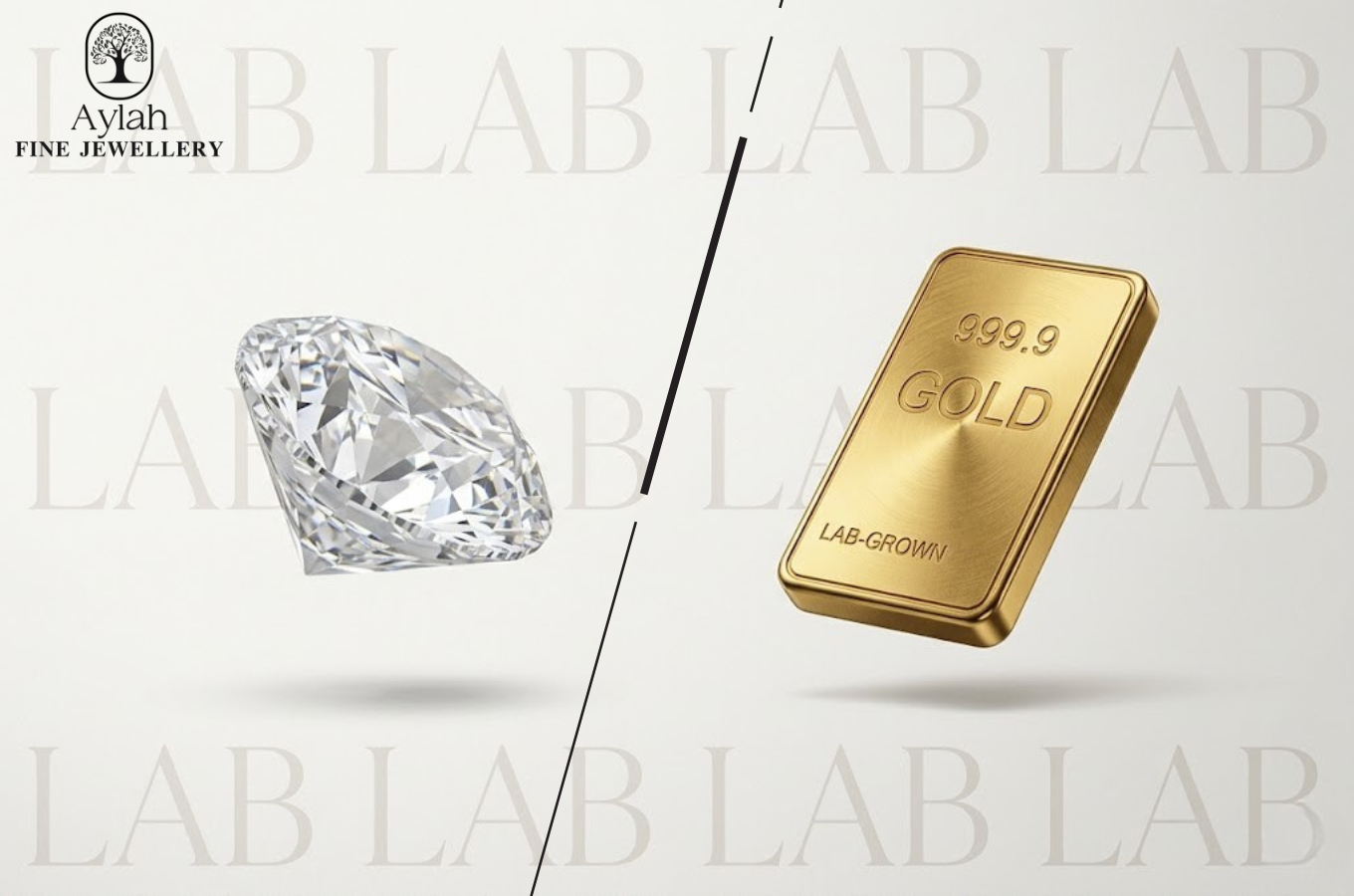
The meaning of sustainability has evolved beyond mere trend to an extremely important element guiding jewellery purchase choices. Hungry for more than just simple beauty and artistry today, prospective owners wish to know how their jewellery has been produced. This is where the discussion of lab-grown diamonds vs lab-grown gold really comes into play.
Either way, they're promoted as ethically sourced, lower-impact, and new tech. But how do they compare? And which one really is better out of the two for the mindful consumer?
Let’s explore.
What Are Lab-Grown Diamonds and Lab-Grown Gold?
Lab diamonds (also called lab-created diamonds or man-made diamonds) are actual diamonds, created inside a controlled laboratory environment rather than in nature. They have the same chemical, physical and optical properties as natural diamonds.
To begin with, lab-created gold is a relatively new concept. Rather than extract gold from the ground, scientists try new processes to synthesise or reprocess gold. If diamond is an under-rarely commercialised, lab-created gold is actually a small breakthrough from the sustainable metallurgy.
Both options simply want to take away some dependence on mining, which is often associated with environmental and ethical issues.
How Lab-Grown Diamonds and Gold Are Created?
Knowing how to make these materials gives us a sense of their value and durability.
There are two main types of methods used for making lab-grown diamonds: High Pressure
High Temperature (HPHT) and Chemical Vapour Deposition (CVD). Using processes that replicate the natural conditions associated with the development of diamonds, subterranean, lab-created diamond products are produced to high-grade specifications.
Lab-created gold, on the other hand, is created using experimental methods in which a particle physics laboratory or other sophisticated recycling of gold from other materials is utilised. Though the concept of artificially producing gold has been around for decades, a facility capable of mass-producing it has remained in its developmental stage.
This difference in maturity is important, as lab-created diamonds are already widely available, whereas lab-grown gold is still emerging.
Sustainability Comparison: Which Is More Eco-Friendly?
If you have been wondering whether lab-grown diamond vs lab-grown gold is better from a sustainability angle. The answer is somewhat complex and hinged on various factors.
Utilising lab-grown diamonds also greatly reduces the amount of land that needs to be impacted by mining, resulting in reduced land disturbance, decreased water consumption, and a significant reduction in carbon footprint. But they take energy to make, and whether they are sustainable or not will depend on whether renewables are being used to produce them.
Recycled lab-made gold can actually be better for the planet. This actually eliminates the necessity of mining and aligns with circular economy practices. But since large-scale production is limited, its full environmental impact is still under investigation.
Currently, synthetic diamonds are the more affordable, sustainable choice, while artificial gold is a good long-run bet.
Cost, Value, and Durability Differences Explained
Cost is one of the most important factors when looking at lab-grown diamonds vs lab-grown gold.
This makes lab diamonds attractive to modern buyers, as they are 30–50% less expensive than natural diamonds. While the price is lower, the brilliance and hardness are the same; they score 10 on the Mohs scale of hardness, so just as durable.
Natural and artificial Gold always maintain inherent worth based on scarcity and global appeal. Gold made in a lab at present cannot command a definitive price advantage due to the nascent state of production methods.
As per durability, diamonds are harder than gold, but gold does not corrode or tarnish. And thus, prettier everyday jewellery.
Therefore, if you want something that sparkles but doesn’t break the bank, lab diamonds are a great option. However, if the long-term value and tradition are the priority, then gold (whether lab-made or not) remains the winner.
Which Is the Better Choice for Modern Jewellery Buyers?
In the end, picking lab-created diamonds vs lab-created gold relies upon your priorities.
If your priorities are cost, sparkle, and accessibility, lab-created diamonds win out every time. Without compromising on quality or aesthetic value, they provide a sustainable substitute.
But if you want to innovate and be sustainable for the long haul, lab-made gold is the coming trend. And it could eventually become a mainstream alternative for "green" jewellery as technologies progress.
However, the dream option for many buyers these days is actually a hybrid: lab diamonds in gold that have been ethically sourced or recycled.
Conclusion
The lab-grown diamonds vs lab-grown gold comparison speaks to a larger trend in the jewellery business. The global consumer has moved beyond wanting just high aesthetics —they are increasingly seeking transparency, ethics and sustainability in beauty.
Today, man-made diamonds dominate the market due to their easy accessibility and affordability, but lab-manufactured gold is a fascinating innovation that could change the game for revolutionary jewellery manufacturing in the coming years.
And as the innovation continues, one thing is for sure: sustainable jewellery is not the future, it is already in the present.
Contact us for more information.